Case study Design System · Figma Mobile 2-week project

How I reduced white-label customization from days to minutes by building a scalable design system

Every new client of a white-label product meant manually restyling dozens of screens — 1 to 2 days of designer time per client. A tokenized, multi-mode design system turned that into a few clicks.

My role: Design system scalability · Client customization workflows
days → mincustomization time per client (from 1–2 days)
0 designersneeded for sales & PMs to build client-ready prototypes
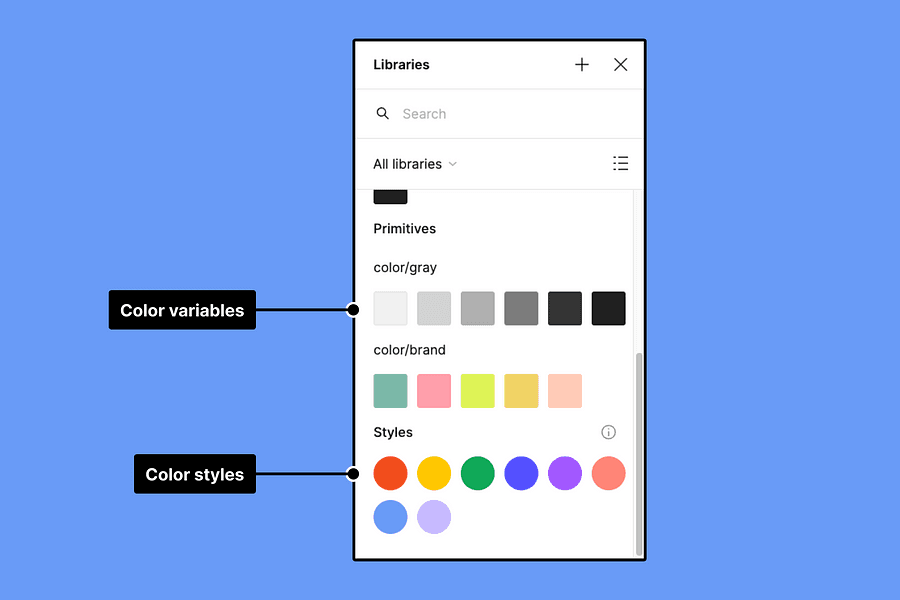
Figma variables panel with tokenized color system

TL;DR

The challenge

Each new client required customizing branding — colors, texts, UI components — across multiple prototypes. What should be quick often took 1–2 days, blocked sales experimentation and kept designers on repetitive work.

What I did

Built a tokenized color system, dynamic text variables and a multi-mode structure in Figma where each client is a configuration — fully integrated with the design system and prototypes.

The impact

Switching clients now takes a few clicks, with the entire interface updating automatically. Sales and PMs create client-ready prototypes without design support.

01 — The problem

Manual work was the bottleneck between sales and a demo.

Presenting tailored solutions was essential for sales and product teams — but every new client meant manually updating dozens of screens, with feedback cycles stretching the process to 1–2 days.

Issue 1Slow turnaround for client presentations.
Issue 2High dependency on designers for simple changes.
Issue 3Limited ability for sales teams to experiment and iterate quickly.

02 — The solution

Customization as configuration, not rework.

1

Tokenized color system

Primary, secondary and complementary colors became tokens — the single source every component reads from.

2

Dynamic text variables

Company names, labels and other client-specific copy switch through variables instead of manual edits.

3

Multi-mode structure

Each client is a mode: one click swaps the entire configuration — fully integrated with the design system and prototypes, so the whole interface updates automatically.

03 — Key insights

Designing for non-designersI intentionally built the system so sales and product teams could use it without design support — reducing bottlenecks and increasing speed across teams.
Variables over static stylesVariables enable real-time updates across the entire UI — something traditional styles can't handle at scale.
Centralized customizationAll customization logic lives in one place instead of scattered across prototypes — making updates consistent and scalable.

04 — Results & learnings

minutescustomization time, down from 1–2 days
self-servesales & PMs create client-ready prototypes independently
fasterclient presentations, iterations and branding experiments

Design systems should go beyond UI consistency — they should enable business scalability. Empowering non-designers unlocked speed and revenue opportunities, and investing in structure upfront saved exponential time later.

By shifting from manual work to a scalable system, we didn't just improve efficiency — we changed how teams collaborated and how quickly the company could respond to new opportunities.